We’re excited to share the first beta (2.1.0b1) for the upcoming 2.1.0 update to Synthesizer V Studio 2 Pro. This release focuses on significant quality-of-life improvements, addressing feedback received since the launch of version 2.
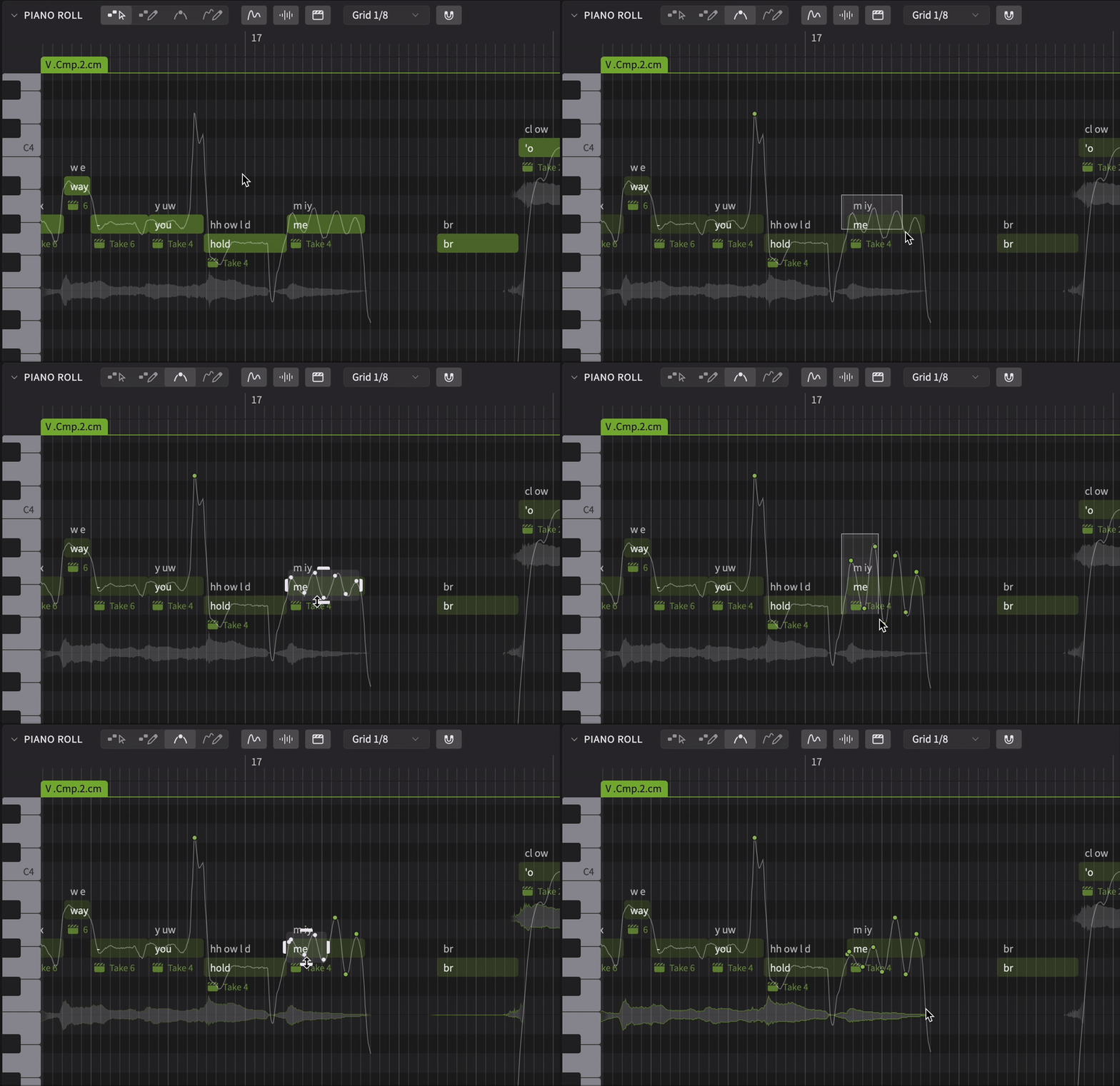
The highlight of this beta is a redesigned Pitch Control Points Mode in the Piano Roll. Now, selecting an area will automatically generate control points that follow the pitch curve’s trajectory. When multiple control points or curves are selected, a new resizing handle will appear, allowing you to instantly adjust the depth and speed of the pitch bends and vibratos.
Beyond the new pitch control capabilities, we’ve added numerous shortcuts and standardized behaviors to align with popular DAWs and sequencers. For detailed information, you may refer to the release notes at the end of this post.
Download 2.1.0b1 Beta Release
Version 2.1.0b1 is a beta version and is offered temporarily through the following links.
Note: we have received reports of crashes when editing pitch control points under Windows. This has been resolved. If you have encountered this issue, please download from this link again.
Reporting Issues
For bug reports, please submit a support ticket through the following form. This allows us to track and follow up on individual cases. Please specify version “2.1.0b1” in your ticket.
I received an email with a new beta version 2.1.0b1.
Yes, still version 2.1.0b1 and no more crashes with the:
“Redesigned Height Control Points Mode” on Windows 11.
Faster startup of the standalone application.
And it will probably be available at the above location of this post. The original file is a little smaller than the new one ( 100,481 Kb and the new one 100,500 Kb )
I wrote “probably” when I had it downloaded and not yet installed, although it was just a small doubt, which is usually what a person has when they are in the above situation. Now I have Synthesizer installed and a data-intensive SVP file open and I am trying to play and make changes. Everything seems to be working so far and peace is coming into my soul. And take my contribution with an exaggeration. Because playing with this beautiful toy in retirement is like returning to childhood.
I think it’s a relief that the conflict issue in Windows has been resolved.
However, we have found a new conflict issue for the pitch control area.
After dragging, erase and drag the newly created point, then drag again, and press Ctrl+Z to restore the erased point, and the new point and the restored point exist together.
When I tried to fix something at this time, it was forced to shut down after frieze.
I delivered the report to the support team on this part.
Unfortunately, I cannot confirm that the listed bugfix for SV 2.1.0b1 in the provided release note above has been successfully fixed on the Windows platform.
Crashes when moving a note group back and forth between tracks:
Both, the standalone and plugin versions, will still crash every time on my Windows 11 24H2 machine whenever note groups are moved between tracks. It doesn’t matter how ‘fast’ tracks are moved back and forth by the user (as pointed out in the fix description); it seems to be a general problem on some particular Intel-based CPUs like in my case. But…
Show a resizing box after selecting multiple points:
Surprisingly, in my case the new feature ‘Pitch Control Points Mode’ works perfectly without any flaws. It’s really strange how so many users can have totally different experiences on their systems when running the same app/plugin…
Still i see from the image that the contrast of the vertical Lines for the bars/beats Is very weak. Why in all the daw this Is very evident but It Is not in synthV???
Bug report here.
I’m on MacOS 15.4.1, running VST3 ARA Sythesizer V 2 Pro in Studio One 7.
First, in standalone SV2 app, every time I try to playback, all tracks start rendering from 0%, thus nothing played back and it stuck.
2nd, in this Studio One project ultilizing ARA mode SV2 VST3 plugin, rendering stuck at a certain point and only one track is audible, 2 others are not.
3rd, there are 3 tracks with 3 instances of SV2 ARA plugins on it. Sometimes Track B would playback the audio of Track A, I try to mute and solo each track and try to edit the notes within SV2, but it just doesn’t work. I try to export it in SV2, and this time the tracks are correct.
I‘ve sent email and hand in that project, hope it would be fixed soon.
Please implement a method to completely transfer the pitch from one vocal performance to another. I want to make Miki sing with Moca’s intense vocal style.
In SV1, I could easily do this by fixing the pitch in manual mode. However, in SV2, using “trace pitch into control point” makes their singing sound bad.
@Dreamtonics:
Not sure why, but when using this beta version in Cubase 14 Pro and altering some voice data inside an opened song’s included SV2 voice tracks, the voices won’t always pre-load right in time during normal playback, so that up to 250ms long dropouts might appear. This is happening across all parallel sounding voice tracks at the same time, and it cannot be predicted when this will happen the next time the song is played back again - it’s always at a different spot. For sure it cannot be related to my Win11 24H2 or the PC system’s specs (Intel i9 12900K / 128GB RAM), so I’m not sure why this always happens. Sometimes the ARA Bridge gets so confused when navigating through the song that the song even crashes when closing, so I guess the issue must be related to the use of the SV2 ARA bridge which still seems to have a glitch (yes, this rhymes but isn’t funny at all). I also noticed that - if I’m saving the Cubase song under a new name (e.g. at a different disk location) - the saved SV2 tempo will not be re-applied in the same way as the Cubase’s song tempo does when re-loading the song. Instead of keeping the song tempo as initially aligned with the Cubase time base, the internal SV2 tempo always jumps back to its “default” tempo “120” when the song is reloaded.
Since my bad experiences with SV2’s “Save to external file” option, all my SV2 data are exclusively stored “DAW internally”, meaning inside the .CPR file, not externally anymore. So why is the tempo inside the included SV2 track not retained (and not equal anymore to the value previously saved) and why are there so many audible dropouts when playing back SV2 voices whenever using this beta version? Is the SV2 pre-loading buffer somehow adjustable anywhere?
I’m very disappointed by that version the longer I’m working with it. It’s currently really a mess. I think I’m going back to 2.07, as currently I have seen enough…
UPDATE:
Bingo. I have just re-installed SV 2.0.7 and everything works well again. The SV2’s tempo is now correctly retained when saving the song and re-loading it. The ARA bridge also seems to work better again without any hickups. In other words, there must have been something changed between 2.0.7 and 2.1.0b - and it wasn’t for the better, I guess.
The idea is good, but the implementation is poor. It’s hard to select individual notes. Most of the time, all nearby notes get selected as well. There’s no option to isolate just the vibrato and control its start, end, amplitude and frequency as a single, unified element. You can probably do that graphically but the current implementation makes it really clunky and unintuitive.