Other Tuning - Why ARPABET?

I’m looking a Felicia…

Here’s the phrase: “Look at the ladder; there’s a paw-print. By Moon-bird’s hot egg, you hear pure cows behind car and boat coin machines.”

Because of the phoneme dictionary being ARPABET - there are missing sounds that British English Speakers use and expect to hear…

Why not move over to X-SAMPA and include the missing sounds so we can all be happy? One notable sound is the ‘o’ in hot, bot, cot we don’t say hæt, bæt, etc too nasal and too much ‘eeee’ in it.

Here’s Felicia (settings comments below):

As already mentioned: the ‘o’ in hot is difficult to get using the American ARPABET spellings. It sound more like hæt. Shifting the tone right down reduces the nasal quality and seems to help?

Word endings t, d, v, s, z are not always pronounced as strongly as expected and completely blank on the phoneme panel. Not even visible on the waveshape and yet can be heard faintly???

Ending to ‘ladder’ is not [er] but [ax] - schwa.

‘And’ is another unpredictable word sometimes und, -nd, an- or ænd - other variations also available!

Felicia was altered thus:

Airy Timbre - 150%; Bright Pronunciation - 150%; Powerful Pitch - 150% and Tone Shift -100 cents (I know these are extreme - but judge for yourself the result)

And just to top if off - fiddling with Felicia to get something akin to what I’d like took much longer than doing the same exercise with Vocaloid 6 AI Sarah…

3 Likes

Now I’m looking at Ninezero…

Here’s the phrase: “The curious white goat named Jaws ate pears near an unusually demure orange owl and a noisy cat.”

Here’s Ninezero:

Once again the word cat with a short -a- sound needs less ‘eee’ so I used the mouth opening to alter it.

General settings used: Solid pronunciation - 120%; Muted timbre - 120%; Gender - 0.25

1 Like

Still looking at Ninezero …

Taking the phrase: “The boss lost the odd box of hot coffee pots.”

The British English ‘o’ (/ɒ/) sound is not what Ninezero produces ‘out the box’! Have a listen:

This sound requires rounder lips, a shorter duration and a tongue slightly lower in the mouth. The first two are doable in SV2 and here’s the result:

1 Like

Looking at Solaria…

Taking the following arbitrary list of words covering all British English vowel sounds: “Crab, Dark, Flair, Way, Check, Smirk, Near, Sea, Rib, Choir, Fly, Throb, Claw, Sure, Brow, Power*, Joy, Crow, Stub, Hook, [and] Glue.”

  • Power / tour as pronounced by posh British speakers, “Loik watt I is…”

I used SV1 - Solaria; SV2 - Solaria which offered the following ARPABET phonemes:
[k r ae b] [d aa r k] [f l eh r] [w ey] [ch eh k] [s m er k] [n ih r] [s iy] [r ih b] [k w ay er] [f l ay] [th r aa b] [c l ao] [sh uh r] [b r aw n] [p aw er] [jh oy] [k r ow] [s t ah b] [hh uh k] [g l uw]

…and (for the fun of it) Vocaloid6:AI Jessica with the following x-Sampa phonemes:
[kh r { b] [dh Q@ r k] [f l e@] [w eI] [tS e k] [s m @r k] [n I@] [s i:] [r I b] [k w aI r] [f l aI] [T r Q b] [kh l O: w] [S U@] [bh r aU] [ph aU r] [dZ OI] [kh r @U] [s t V b] [h U@ k] [gh l u:]

The following audio shows all three singing together then individually in the order SV1; SV2 and Vocaloid6

Conclusion
Vocaloid 6 offers greater control over vowel sounds there are 21 when compared to SV’s offering of just 16.

Here’s a list of British vowels: ɪ, ɵ, ɛ, ʌ, ɔ, a, ə, ɑ, o, ʉ, and semivowels j and w

and the words you listed:
Crab - a
Dark - ɑː (the ː sign means it’s a long vowel, you just hold it longer)
Flair - ɛː
Way - ɛj
Check - ɛ
Smirk - əː
Near - ɪː
Sea - ɪj
Rib - ɪ
Choir, Fly - ɑj (Choir is two syllables: ɑj + ə)
Throb - ɔ
Claw - oː
Sure - ɵː
Brow, Power - aw (Power is aw + ə)
Joy - oj
Crow - əw
Stub - ʌ
Hook - ɵ
Glue - ʉw

Also needed:
Comma, About (the A sound) - ə

Here is how to make these vowels using SynthV’s phoneme set:

The semivowel j corresponds to: English y, Japanese y, Mandarin Chinese j, Cantonese j and :i, Spanish I, and Korean j
The semivowel w corresponds to: English w, Japanese w, Mandarin Chinese w, Cantonese w and :u, Spanish U, and Korean w


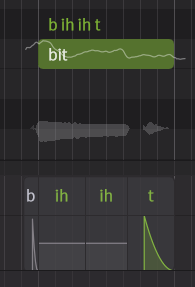
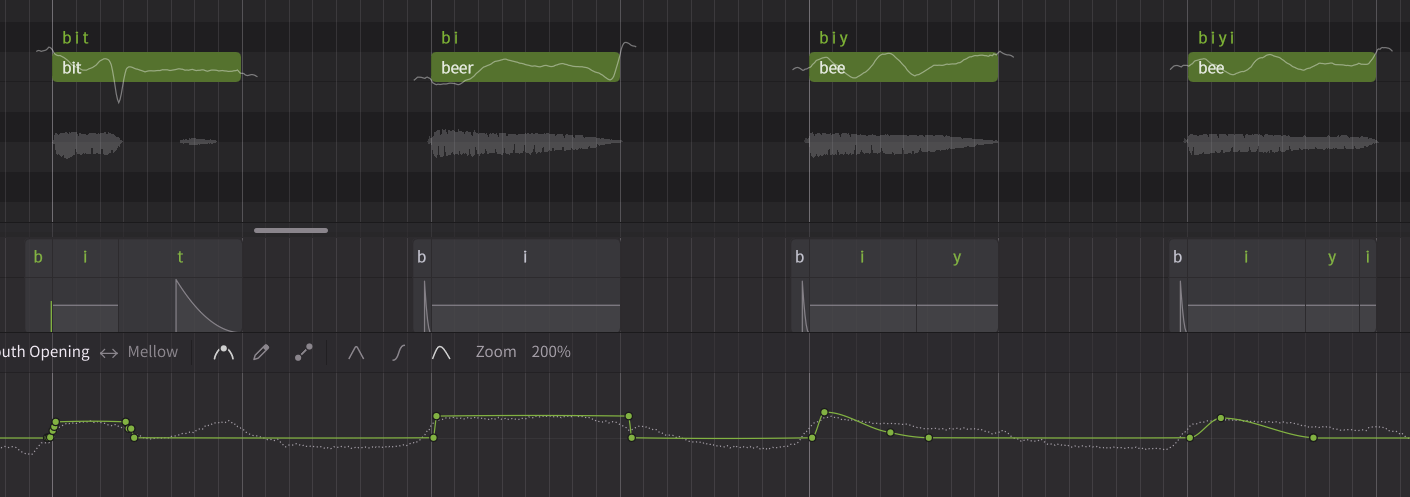
  1. ɪ. Examples: Bit - ɪ, Beer - ɪː, Bee - ɪj

Use English ih or Cantonese I. When French arrives, you can also use the vowel that it gives for clé (not sure what the representation of this sound will be, but you can try typing in the word clé once it arrives and use that). Chinese voicebanks may struggle with these sounds and make them muddy before certain consonants, so you can double up the phoneme (ih ih) to enhance clarity.


For Cantonese, if both I and I I fails, use i I to force a clearer vowel
Alternatively, you can use the phoneme “i” from any language other than English and subtly increase mouth opening to make it sound correct. (notice that in the screenshot the Zoom is set to 200%)

Notice that for ɪj, you only apply Mouth Opening to the ɪ part and not the j part. If you set Mouth Opening throughout the diphthong, it will sound more like ɪː rather than ɪj.

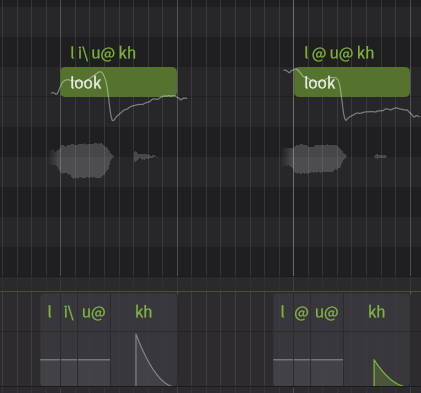
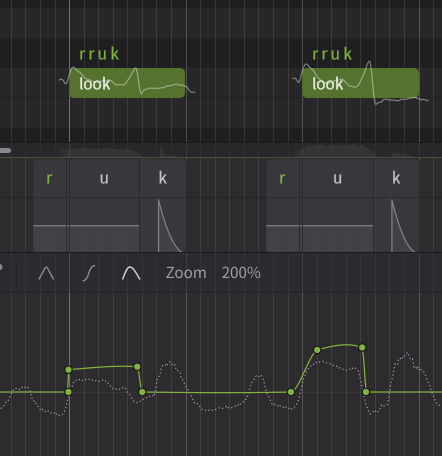
  1. ɵ. Examples: Look - ɵ, Lure - ɵː

For this use Mandarin u@ or Cantonese 8. Sometimes English uh will work but most of the time it will be too accented. Cantonese 8 might reach too far back into o territory, and might sound wrong. I’d recommend waiting for French to be able to use this sound, as it exists in many common French words, such as le, de, je, ne, que, ce, me, etc.
For now, Mandarin u@ is the closest, but sometimes you might get an unwanted W glide. To get rid of it, you can add an additional short vowel such as “i\” or “@” before it. I’d also recommend trying Japanese u + Mouth Opening.

If using the Japanese u, differences in Mouth Opening can subtly change the accent.

  1. ɛ. Examples: Bed - ɛ, Bear - ɛː, Bay - ɛj

Use English eh, Japanese e, Mandarin e, Cantonese E, Spanish e, Korean e_o.
If your ɛ ends up sounding too much like an ɪ (so Bed, Bear, Bay sound more like Bid, Beer, Bee), use Mouth Opening to fix it (but again, watch out not to put Mouth Opening on the j part for ɛj). If you’re using English eh and it sounds wrong, you may want to use ae, or double up the phoneme (eh eh) to enhance vowel clarity.

  1. ʌ. Examples: Stub - ʌ

Some speakers have a brighter timbre sound (/ɐ/) which is Cantonese 6
Other speakers have a darker timbre sound (/ʌ/) which is Korean V
You can use any of these (arranged from brightest to darkest)
Cantonese 6, English ah, Mandarin 7, Mandarin A, Korean V

  1. ɔ. Examples: Bob - ɔ

Use English ao, Japanese o, Mandarin o, Mandarin uA, Cantonese O, or Spanish o. If it sounds too much like “ahh”, reduce the mouth opening.

  1. a. Examples: Cat - a, Cow - aw

Japanese a, Mandarin a, Mandarin ia (you can use “a ia” to remove i-glide from ia), Cantonese a, Spanish a, Korean 6. Also, you can use English ae with Mouth Opening, or English aw (for aw sounds)

  1. ə - Examples: A - ə, Bird - əː, Go - əw

English ax, Mandarin @. For əw specifically, English ow, Mandarin @U, Cantonese 9 :u

  1. ɑ - Examples: Dark - ɑː, Dye - ɑj

English aa, English ao, Mandarin A, Mandarin uA

  1. o - Examples: Saw - oː, Soy - oj

Japanese o, Mandarin U, Cantonese o, Cantonese U, Korean o
also English ao (with reduced mouth opening), English oy (for oj)
French will use the sound in the word eau

  1. ʉ - Examples: too - ʉw

English: uw, Japanese u
I think the Mandarin y with mouth opening is a very convincing sound for ʉ (maybe also Cantonese but I don’t know for sure)


Here you can hear what it sounds like

As for the example sentences I used ChatGPT: