Maybe some kind of AI room simulation?
1 Like
That makes more sence than some ideas but an impulse response acoustic model wouldn’t require that speaker?
2 Likes
Hasn’t Dreamitonics make up their minds?
Linux support for SynthV 2? Else I am not interested.
If someone guesses correctly, do they get a free (or at least discounted?) license for the new product?
We’ve got a few clues:
- The dodecahedron speaker
- The new product logo
- Human nuance is not a switch.
- The anatomy of resonance.
- Where the sample ends, the performance begins.
The logo first. Same design language, yet different identity. Not the same shape, not the same color palette. To me this hints at a distinct product, not SynthV 3.0. That product might be side by side with SynthV, or maybe integrate with it, or maybe a successor to SynthV that could not be SynthV 3.0 maybe due to breaking technology change.
The three headlines to me hint at moving away from sample based synthesis, to something capable of physically modeling a full spectrum. Now, from what I understand, this is what newer AI-based SynthV voices do. Unlike the older voices that were sample-based, newer voices are neural networks trained to reproduce the characteristics of the voice it was trained on (or at least, that is what Gemini explained me when I asked it whether SynthV voices were sample-based).
This leads me to think that maybe the same principle they use for AI voices could also be extended to virtual instruments. SImilar technology than for voices, but trained on instrument performances rather than voices.
This is a feature that ACE Studio has added relatively recently, so it wouldn’t be surprising at all if Dreamtonics wanted to roll out their own version to keep up with the competition.
Might also be trained on room acoustics, as the dodecahedron speaker could possibly hint.
2 Likes
Perhaps we’re getting a physically modeled vocal synth?
That’d imply my dream became true.
If someone guesses correctly, do they get a free (or at least discounted?) license for the new product?
They could at least give everyone a free license for us waiting and them never replying and never improving their products.
That was my initial idea until the “Where the sample ends, the performance begins” clue, which makes me lean a bit more towards instruments based on similar tech as the voices.
Why V1 Voices Sound Better in Synthesizer V Studio 2 Pro | Dreamtonics
So, ACE studio is trying to catch up then and, as usual, AI “information” is just a giant glob of ripped data with no traceability, able to con anybody that falls for it.
It’s a very real possibility. So take a look at this thread from March on the subject : Speculative Thoughts on the Possible Evolution of the Engine (2026–2027) - Synthesizer V Studio - Dreamtonics Users Forum
I’m with @KorSkarn I think a physical modeling based instrument performance engine. Hopefully they’ll keep it completely separate to Synth-V, like they did with Vocoflex. No issues with it as a direction, but I would hate SV to lose its focus as a product.
I don’t give a f*. When are you going to work on improving French and German pronunciations ? When are you going to read what we write here ? When are you going to care about your users ? We give you freaking truckloads of money and you don’t even listen to us. We send you ideas and you don’t even bother reading us. We ask for improvements and you don’t do anything. What’s the use of selling products and abandoning and ignoring your users ? WE GIVE YOU MONEY, FFS.
5 Likes
Come on - not very nice is it ? I think its very interesting and will give it a try
2 Likes
I like it, but I don’t like the price .. 
1 Like
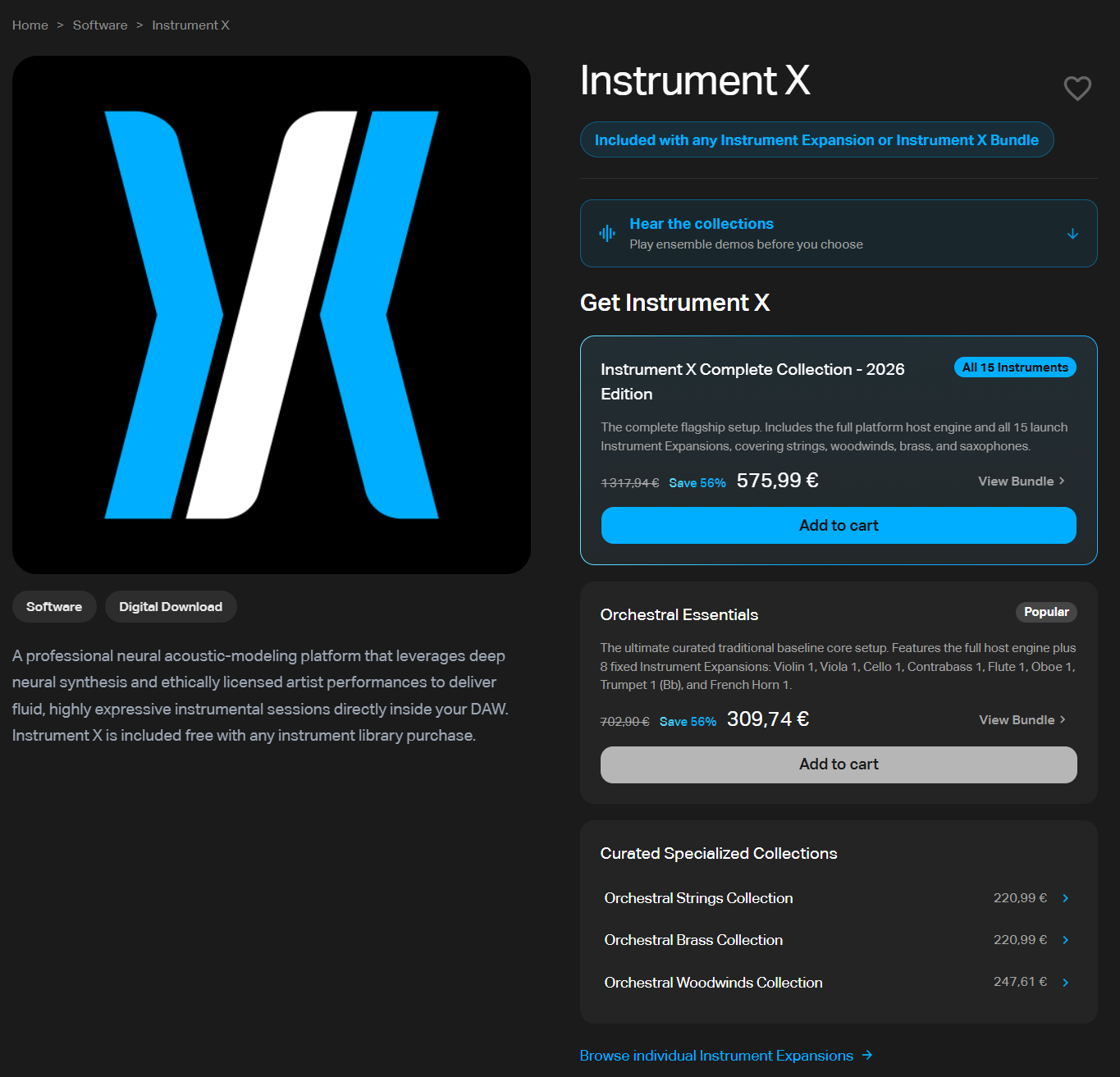
What a magnificent new product! Thank you to Dreamtonics for launching it. Sure, it was predictable and widely anticipated, but I still did not expect to see so many instruments arrive all at once. Congratulations, you crafty keepers of secrets…
The next question now is: what are your plans going forward? Will Instrument X remain a closed platform intended solely for internal use (which seems unlikely to me), or do you envision becoming the new KONTAKT, with third-party developers creating instruments for it, much as happened with Synthesizer V?
I am already impressed by the level of polyphony the system appears capable of handling. That suggests that the piano is probably no longer far away, along with the rest of the keyboard instrument family.
That said, polyphonic instruments will raise several fundamental questions:
1. How will synthesizers be handled?
What about sound synthesis itself? The current neural modeling approach seems designed to reproduce acoustic performances rather than generate entirely synthetic sounds. This opens up a whole new avenue of development.
2. Some polyphonic instruments, such as the guitar, present more complex modeling challenges.
A first option would simply be to play the MIDI data exactly as provided by the user. In that case, unrealistic inputs would become the user’s responsibility, such as playing seven notes simultaneously on a six-string guitar.
A second option would be a string-management system comparable to that of AMPLE SOUND, though such a system would be lengthy and complex to develop.
A third option would move closer to the long-envisioned EZGUITAR concept that Toontrack never fully realized: performance patterns that automatically adapt to a chord progression supplied by the user. Native Instruments’ guitar products already move partially in this direction, but without offering full note-level editing. This is not only a major technical challenge, but also one that requires significant design decisions.
A logical next step would be the introduction of performance prompts.
To be clear, I am not talking about replacing the composer with an AI system capable of composing or arranging music automatically. SUNO already occupies that space. Rather, I am thinking of musical instructions comparable to those a conductor gives to performers: telling the clarinet, “play this passage more delicately,” asking the violins to “build a crescendo here,” or saying “add a stronger vibrato at the end of the phrase while lightening the tone.” Such instructions could complement, rather than replace, all of the detailed controls that already exist.
In any case, a tremendous opportunity is now opening up for Dreamtonics. Competitors whose business model is based primarily on the sale of audio samples seem to be heading toward a dead end unless they evolve.
There is, however, one potential threat on the horizon: DAW developers.
Steinberg has already begun integrating vocal technologies into Cubase. Tomorrow, DAW vendors may decide to integrate deep neural network-based instruments directly into their platforms as a major differentiating feature. If that happens, the competitive landscape could change very quickly.
So move fast.
The market must be captured before it closes again.
The objective should be to become the industry’s indispensable standard.
2 Likes
C’est plutôt une bonne idée, mais un mauvais timing je trouve. Il y a une forte demande d’amélioration des langues, et la création de nouvelles.
Nous sommes tous ici pour les voix !
3 Likes
The sound quality, from what I can hear in the demo, is quite poor. I’m negatively impressed by the transitions between legato notes, which are truly sloppy. Some instruments are excellent with staccato, but others are almost annoying to listen to and resemble synth sounds. I don’t think they can compare to virtual instruments like those from Acoustic Samples or Samplemodeling, which offer great versatility and are much more realistic and expressive. I hope this is just the beginning; a lot of work remains to be done, and I expect something as extraordinary in the future as Dreamtonics’ current vocal synthesis.