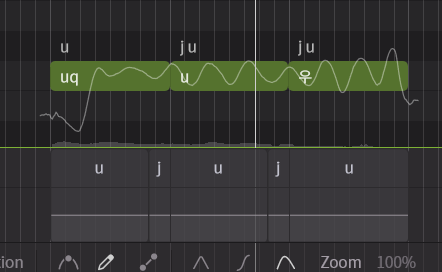
When Korean was announced to be included in Synthesizer V Studio 2, I was extremely excited. I am a Korean speaker, and a huge fan of Korean vocal synthesis - which is why I was doubly excited to learn that UNI was going to be the first native-Korean vocalist for Synthesizer V 2. However, while I believe UNI’s quality is exceptional and the most enticing aspect of the new generation of the software, there are some problems with the Korean language that I noticed.
Cannot pronounced 우
If you type the Hangul “우” in Synthesizer V Studio 2 (as of version 2.0.1) right now, a vocalist cannot properly pronounce it. This is not due to bad programming, but the fact that it is using the wrong phonemes entirely. 우 is a stand-alone vowel, and should be phonetically transcribed as [u], but for some reason it is being transcribed as [j u]. This is simply not correct, in any context. There is 0 situations where 우 would be pronounced as [j u], that would be for 유.
Lack of Batchim Support
Batchim (받침) refers to consonants at the bottom of a Hangul block in Korean, specifically how said consonant will “prop up” or “support” the next consonant (or lack thereof). This is, as far as I know, a rather unique aspect of the Korean language. However, there are very strict rules and combinations, making it rather easy to work into a software. For example, VOCALOID3 and 4 which were released over a decade ago had proper Batchim support - and they didn’t even utilize things such as G2Ps or AI at all. Here are some examples of Batchim:
것이 → If you were to type 것 + 이 into Synthesizer V Studio 2 right now, the phonetic transcription would be [g V t] [i]. In isolation, it is true that “것” would be pronounced [g V t]. However, since it is a batchim, and there is something after it, it would not be pronounced this way. The batchim would be carried over to the next syllable block, and pronounced [g V] [s i].
Here’s a full sentence example! If I were to type “음식을 먹는 것을 좋아합니다” into Synthesizer V Studio 2, it would be phonetically transcribed as:
[M m] [s i k] [M l] [m V k] [n M n] [g V t] [M l] [dz\ o] [a] [h a p] [n i] [d a]
This is NOT correct! It should be:
[M m] [s i] [g M l] [m V N] [n M n] [g V] [s M l] [dz\ o] [a] [h a m] [n i] [d a]
Batchim support is incredibly important for convenience and accurate word-based input. While we can write in phonetic-hangul, ie instead of typing “것이” we type “거시,” it’s much faster (and simpler) to simply have proper Batchim support. This is an incredibly significant part of the language, but I also acknowledge that creating a language takes resources and time. Since there are workarounds, it is not something that needs to be rushed out the door, but please do invest the time and effort into creating this support within the G2P by rule-based transformation.
Lack of ɕ
This will be a little less feasible, likely, but something that I similarly take issue with in the Synthesizer V Studio 2 Korean language system. As it stands, Synthesizer V does not distinguish between ɕ (what we may call sh) and s. For example, “시루” is not actually [s i 4 u], it would be [s\ i 4 u] (like shi-ru). I suspect that these two realizations were merged into one phoneme due to its prevalence, meaning there would be no lack of data support. SynthV is not the only system to have done so, but the others were typically Korean-only or Korean-focused. As far as I can tell it does work…but at a pretty significant cost.
When using UNI in any other languages that do have [s i] (not shi), such as “see” in English, she inevitably ends up sounding like she’s saying “shi.” It’s the same with words or phrases such as “kiss your face” she will just say “kish your face.” On the flip side, when using non-native Korean vocalists in Korean through XLS, their 시, 샤, 셔, 쇼, etc will all sound like “s” when it should sound like “sh” (ɕ / sh). I know this would require some more in-depth adjustments, but it could in theory be done through find+replace instances and automated heavily. I think it would be the best for the language and SynthV infrastructure as a whole if the merged realizations were properly separated.